
We have always believed in our values and in our people: weft and warp of our DNA.
1927
Foundation
Brunello was founded in 1927 by Giuseppe and Maria Ghiringhelli, the grandparents of the current General Manager, Elisabetta. They began this adventure on the slopes of the Varese Prealps in the town of…
1927
Foundation
Brunello was founded in 1927 by Giuseppe and Maria Ghiringhelli, the grandparents of the current General Manager, Elisabetta. They began this adventure on the slopes of the Varese Prealps in the town of Brunello.
Today Brunello is a glocal textile company, deeply rooted in its territory of origin and focused on expanding into markets worldwide.
“In reality, there is evidence of my family’s involvement in the Brunello textile industry as early as the 15 century. My grandfather Giuseppe, together with his brothers Luca and Carlo, had a passion for textile mechanics from an early age, so when he returned home from the front at the end of the First World War he decided to attend weaving courses in Varese. He then asked his father Ambrogio if he could start a small business in the garden of their home in Via Marsala 1. His first concern was producing electricity for industrial use which had not yet arrived at Brunello. He did this by equipping himself with a diesel engine system, and subsequently installed the first ten looms. Thus, his adventure began, for some time with his brother Carlo and then alone with his wife Maria. They produced wool and cotton fabrics and sold them to wholesalers in the Busto and Gallarate area. They thought about everything: procuring the yarns, weaving them, packaging them and delivering them. It was a hard and tiring daily commitment.”
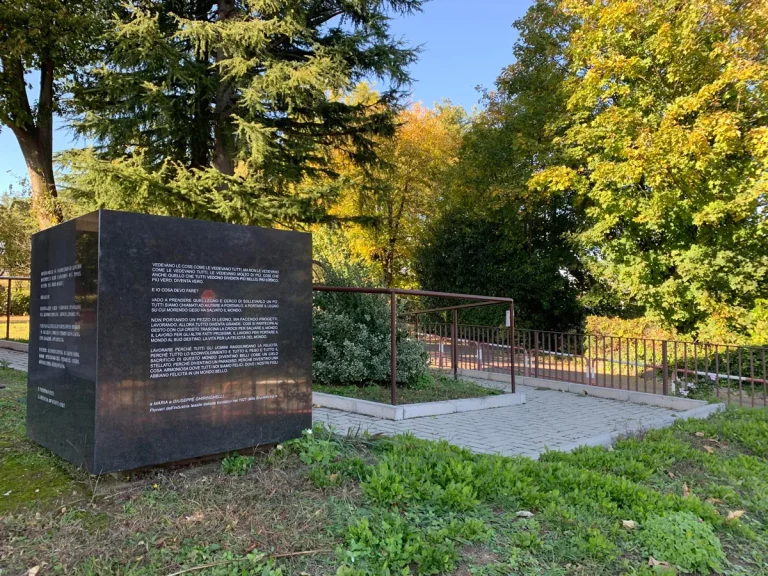
In the photo: monument inside the playground of Brunell’s nursery school honouring the company’s founders, Giuseppe and Maria Ghiringhelli, to commemorate the company’s bond with the community and its commitment to the personal growth of new generations
1935
Artificial fibres
Today, the weaving of artificial fibres is the core business of Brunell’s production, which was the response to a period of crisis in the textile industry. The colonial wars of the 1930’s…
1935
Artificial fibres
Today, the weaving of artificial fibres is the core business of Brunell’s production, which was the response to a period of crisis in the textile industry. The colonial wars of the 1930’s imposed heavy punitive sanctions against Italy, creating an autarkic economy that made it difficult to secure the raw materials needed to produce wool and cotton.
“Then in 1935, the sanctions imposed on Italy complicated matters and it became impossible to procure yarn. Debating about what to do during this difficult period, Giuseppe and Maria gathered information and discovered that Italian artificial yarns, such as Lanital and Rayon, were being produced in Torviscosa. A type of cane was being grown in this area from which was extracted the cellulose needed to make the famous opaque cloth that would replace cotton fabrics and later would form the basis of the linings. They were first in the district to use these yarns, and they began to make taffeta, twill and satin. When the war was over, these would be the only fabrics used for garment linings and would allow the company to expand their business. Thus, they added a first extension to the first factory of 10 looms, and then a second one in the 1950s, reaching a total of more than 100 looms. With his generous nature and great foresight, Giuseppe gave several young people in the area between Azzate, Gazzada, Daverio and Jerago the opportunity to start the same activity, providing the raw materials and orders and support and allowing the textile district of this area to be established.”
When the Second World War arrived, the small company was on the verge of closing. They were very difficult years in every respect, everything was woven, from medical gauze to opaque canvas for underwear. After the war, the ‘lining’ adventure began and the company’s ultimate specialisation in the use of artificial and synthetic fibres took off.
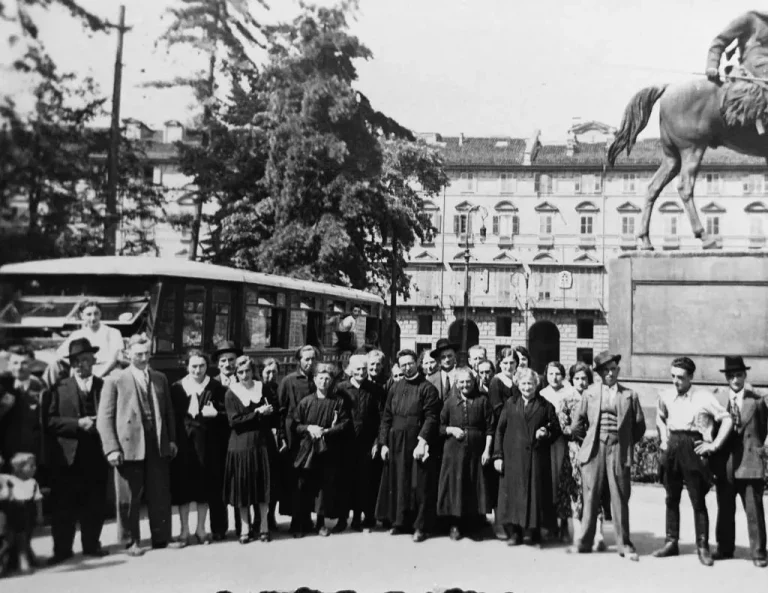
In the photo: company trip to Turin, Brunello’s first team building. Brunello has always shared its family values, objectives and moments of joy.Then in 1935, the sanctions imposed on Italy complicated matters and it became impossible to procure yarn…”
1956
Female leadership
A company that still has a feminine culture, which exports its products all over the world thanks to a forward-looking strategy.
“My grandfather Giuseppe passed away in 1956 and my mother…
1956
Female leadership
A company that still has a feminine culture, which exports its products all over the world thanks to a forward-looking strategy.
“My grandfather Giuseppe passed away in 1956 and my mother Anna Maria, born in 1932, was “forced” to take over the industrial business, accompanied by her sister, Rosanna. Imagine what it must have been like for a woman to run a business at that time. She did it with great foresight, combined with a strong character and a desire to be hugely successful! To the fist company shed, my mother added another four. When my grandfather was president, the company consisted of 80 looms and 2 sheds, with my mother this grew to more than 400 textile machines and five buildings, thus laying the foundations of what Brunello is today. My aunt Rosanna supported my mother: with her warm and outgoing personality, she lightened my mother’s mind, who was very work oriented. The combination of these two women was fundamental for the company. At the age of forty, in 1972, my mother married my father, Gaetano, born in 1929, and was born in 1973.”
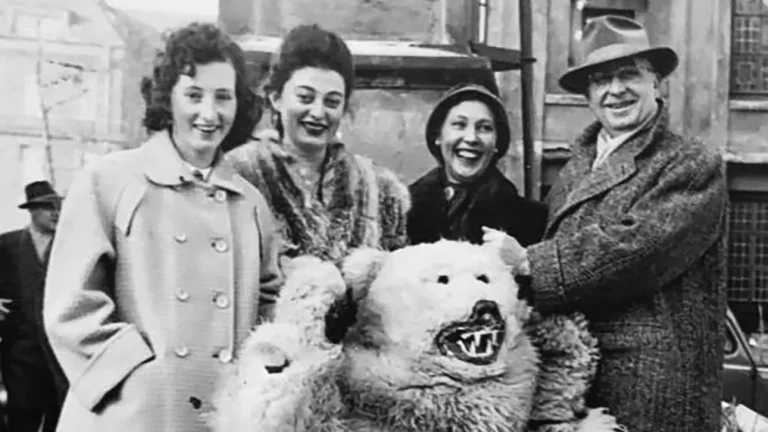
In the photo: from left, the two sisters Rosanna and Anna Maria together with the commercial agent and his wife during their visit to the ENKA factory in Wuppertal, Germany in 1956
1960
Mass production of garments
In the 1970s, custom tailoring was gradually being replaced by the mass production of clothes, which called for the use of advanced sewing machines and techniques that allowed the garments…
1960
Mass production of garments
In the 1970s, custom tailoring was gradually being replaced by the mass production of clothes, which called for the use of advanced sewing machines and techniques that allowed the garments to be made in a short time, while maintaining some manual processes.
“In the 60s and 7Os, the mass production of garments had replaced handmade tailoring, this led to the creation of the garment maker. Marzoto was the first customer, followed by many others including GFT, Zegna, Corneliani, Lubiam, Lebole, Canali, Isaia and gradually all the leading Italian clothes manufacturers. The hallmark of the Brunello linings was and is the quality that is expressed primarily through the use of cutting-edge machinery. In the span of only 10 years, we went from the shuttle, to the Unifi loom winder, to the air loom, quickly renewing the technical facilities, systems and installations.”
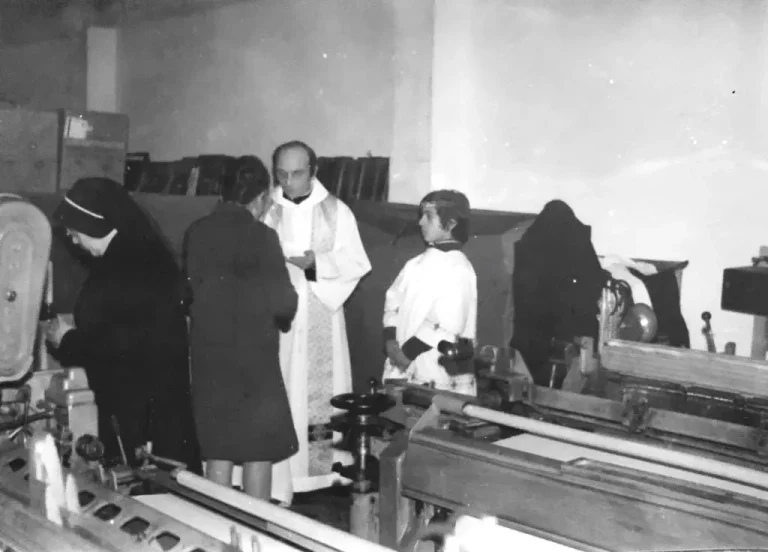
In the photo: weaving room of the time during the celebration of Holy Christmas Mass. The weaving room has always been be fulcrum of Brunell’s activity, the heart and soul of the company. Not only are our fabrics made here, but it is also the place where those professional and human relationships that form the company’s know-how are established.
1970
Internationalisation
Brunello believes in the strength of its values in order to differentiate itself and to expand it international reach, becoming more and more interconnected.
Our products are made-in-Brunello, but they are sold…
1970
Internationalisation
Brunello believes in the strength of its values in order to differentiate itself and to expand it international reach, becoming more and more interconnected.
Our products are made-in-Brunello, but they are sold and used worldwide.
“In these years, the markets have expanded and from Italy our products are now delivered to leading companies all over Europe, such as Biderman in Paris, Mark& Spencer in London, El Corte Ingles in Madrid. When the sales representatives and direct personnel opened their suitcases, it was a general chorus of compliments: beautiful fabrics, beautiful textures, fantastic designs. They were truly rewarding and gratifying years.
The impetuous wave of “Made in Italy” subsided, but to keep the interest of consumers alive, garment makers began to double, differentiate and characterise their collections more and more, and the linings also had to adapt to these new paths. We saw the introduction of dyed yarn, different yarns, from stretch to silk, to cottons and lurex, as well as special finishes such as those obtained from dyeing, coating, wrinkling, delavé, washing.
Brunello worked hard and acquired a new professionalism, so much so that we are now able to make fabrics for ties, ceremonial wear, full-height jacquard and fabrics for the so-called English crowd.”
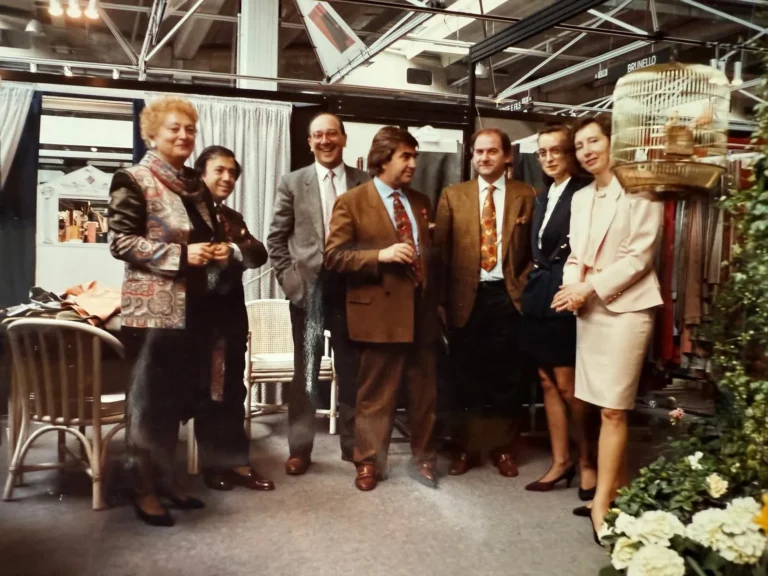
In the photo: A shot from Moda In featuring Dr. Elisabetta Gabri, Mrs. Annamaria and Mrs. Rosanna Ghiringhelli, and the then Sales Manager, Mr. Bernardo Pernetta, along with some clients
1980
Innovation
The looms of Brunello produce an average of 15 million metres of fabric every year. The core business is artificial fibre linings. It also specialises in jacquard fabrics, and has become the largest…
1980
Innovation
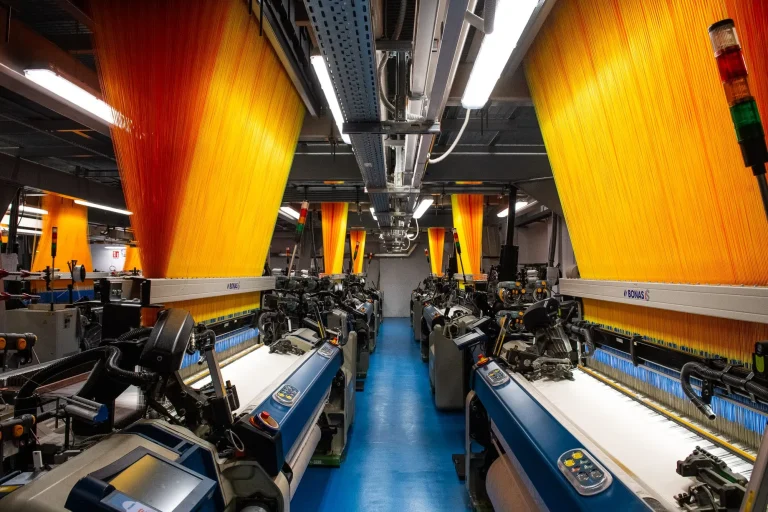
The looms of Brunello produce an average of 15 million metres of fabric every year. The core business is artificial fibre linings. It also specialises in jacquard fabrics, and has become the largest company in Europe in this specific sector.
“From my parents l inherited the determination and strong desire to make beautiful things and to make them well, together with the love for innovation.
We were one of the first companies in the world to experiment with the combination of the jacquard machine mounted on an air loom. This was also thanks to the invaluable collaboration of our production manager at the time, Engineer Ferioli, who was a fixture at the company, even in his 80s. The vocation for innovative change is crucial for building our future, and technological development must be constant. It is imperative to steadfastly believe in what you are doing. This is why we produce everything we sell. This is why we are proud to produce in Italy!”
In the photo: jacquard looms from Brunello’s fleet of machines
1997
The new generation
Today the company is led by Elisabetta Gabri, general manager, who looks to the future while preserving the values that have accompanied the history of Brunello.
“I started working in…
1997
The new generation
Today the company is led by Elisabetta Gabri, general manager, who looks to the future while preserving the values that have accompanied the history of Brunello.
“I started working in the family business in 1997, after graduating in Economics. At first, I was involved in the computerisation of the company, then I moved to the sales area and then to the production area. The generational changeover was traumatic, it had to be. To understand and manage you must know how things work. I have always been absolutely convinced that your work perspective is only correct if you know when your time is up. This is why each of us, at some point, have had to pass on the baton. I officially became president in 2007. Recently, the speed of change in the world has been remarkable. The key to surviving in such an era is sharing. We are no longer living in an era where a single person can carry on the business alone. The success of a company depends on the abiliy to form a team that shares the same goals, where the members work closely together, exchanging ideas and information. The keywords for the success of our family business in Brunello are sharing”, “enthusiasm” and “commitment to values.” I am currently working on reorganising the production processes. We now manage the entire fleet of machines through IT, this allows us to quickly identify problems and improve productivity. In the future, we will concentrate our efforts on continuing to invest in improving efficiency, reducing energy consumption and waste and improving our facilities.”
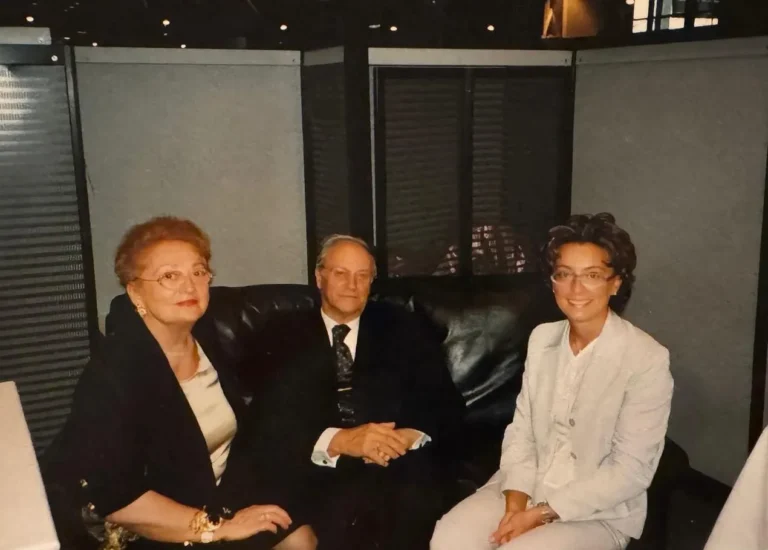
In the photo:Dr. Elisabetta Gabri with her parents, Mrs. Annamaria Ghiringhelli and Mr. Gaetano Gabri.
1999
Expansion
More than 65,000 square meters of surface area, 1,300,000 kg of raw materials used, 15,000,000 meters produced annually: today Brunello is the result of investments and innovation that have always been the engine…
1999
Expansion
More than 65,000 square meters of surface area, 1,300,000 kg of raw materials used, 15,000,000 meters produced annually: today Brunello is the result of investments and innovation that have always been the engine for propelling it into the future.
“Between the 1990s and 2000, after consolidation of its professionalism and experience, other variables had to be introduced into the company to meet and continue to meet the demands of the market: new logistics both in shipping and production, new sales and administrative offices, revolutionary IT at all levels of the company, revolution of times. The relationship with the customer is no longer subordinate, but has become a close and highly personalised collaboration. Those who come to visit us do not only find looms that thump day and night, churning out 15 million metres of products per year, a finished products warehouse of 15,000 sqm, a showroom with about 20,000 items on display, a style office capable of turning every idea into a real and immediate creation; they also find our history and the stories of the people who work with us and have our same values, since 1927.”
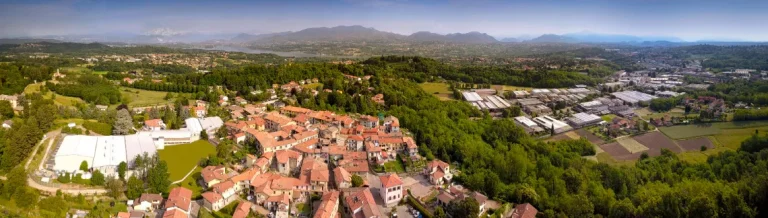
In the photo: the administrative and logistics headquarters of Brunello located in the town of the same name
2006
New investments
Today the company has five industrial buildings in the heart of the municipality of Brunello, plus the logistics and quality areas in the industrial zone of the municipality. It employs a total…
2006
New investments
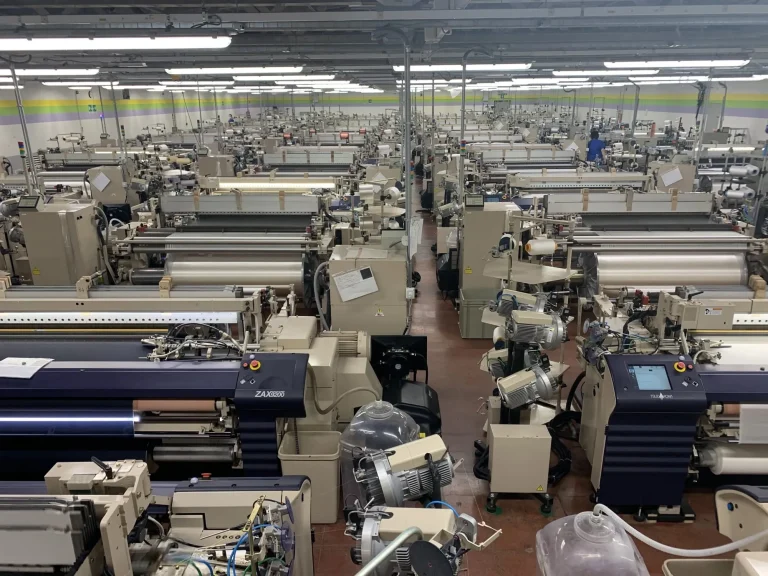
Today the company has five industrial buildings in the heart of the municipality of Brunello, plus the logistics and quality areas in the industrial zone of the municipality. It employs a total of 120 people and annually invests more than 1.5 million euros in the improvement of the production processes, energy efficiency, research and development of new products.
“Starting from 2006, it became strategic to invest in the company: we purchased new looms, jacquard machines and modern equipment and technologies, we upgraded the electrical, fire and air conditioning systems to comply with the new regulations and to become more energy efficient, we installed a new water collection and treatment plant, we renovated the buildings. We have also installed a large photovoltaic system with a capacity of 1 Megawatt on the entire roof of our logistics site, an area of 12,000 square meters, and we have changed all the compressors so that our looms are now operated by compressed air. Another major strategic area of investment is production diversification: we have entered the medical sector with the so-called “silk patches” made with acetate, the “ceremonial’ fabrics sector (clothes for Pignatelli and recently, we have started collaborating with the Polytechnic Institute of Milan in order to ‘give new life’ to production waste.”
In the photo: weaving room with dobby looms
2019
BemBAZIN ™
BemBAZIN™ is an innovative and precious fabric for African Damask produced by Brunello. The fabric is made with Bemberg™, a Japanese yarn obtained from cotton fibre through a highly technological process that,…
2019
BemBAZIN ™
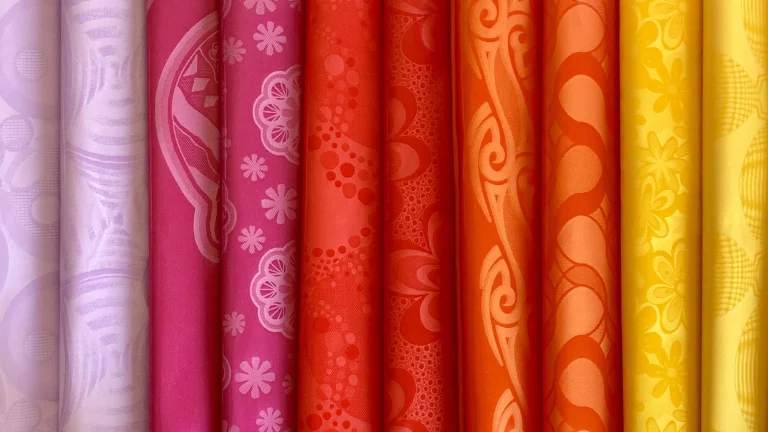
BemBAZIN™ is an innovative and precious fabric for African Damask produced by Brunello. The fabric is made with Bemberg™, a Japanese yarn obtained from cotton fibre through a highly technological process that, woven in combination with the finest cottons, gives life to high quality fabrics with innovative technical characteristics.
“Lining is our core business, but at the same time we have always wanted to expand our work and enter a new market. When we received a request for a 100% cotton JQD fabric from Africa, we initially rejected it because we couldn’t use the natural fibre as a warp thread. However, because we were interested in this project, we tried using Bemberg™ as a warp thread and obtained excellent results. We showed the test product to the customer, who appreciated its three-dimensional appearance, shine and breathability. Based on this product, we carried out some research and began developing traditional African garments called Bazin, acquiring a patent for the fabri under the BemBAZIN™ brand, which incorporates the name Bemberg ™, the main yarn. I hope this helps us to establish an image of Brunello as a high quality product in Africa as well.”
In the photo: BemBAZIN™ in different colours and patterns
OGGI
The future proudly Made in Italy
“We only sell what we produce at Brunello, we do not market anything, and this is a source of pride for us, which we try to convey to…
OGGI
The future proudly Made in Italy
“We only sell what we produce at Brunello, we do not market anything, and this is a source of pride for us, which we try to convey to all the people we meet…”
Since 1927, Brunello has been committed to and passionate about one thing: that of guaranteeing products of the highest quality, looking towards the future while remaining faithful to tradition. An Italian company for an Italian product.
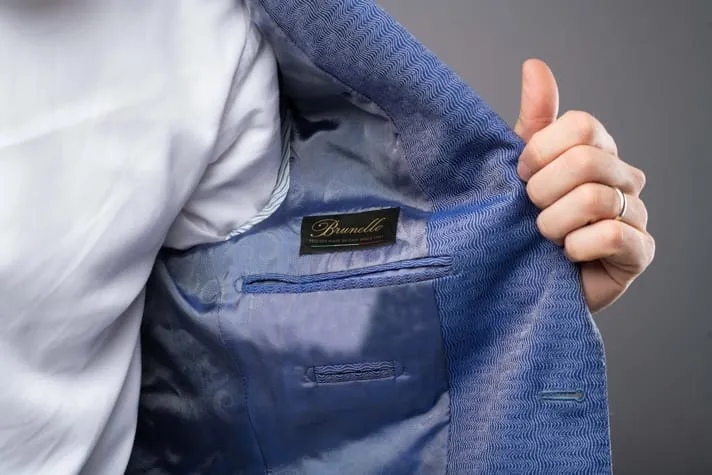
“We only sell what we produce at Brunello, we do not market anything, and this is a source of pride for us, which we try to convey to all the people we meet. It is no coincidence that four words are printed on our business cards that represent our ‘ reason for being’: Proudly Made in Italy! Our other strength: social responsibility. The company must ‘feed’ its people and must do so with the pride of its origins which must never be betrayed. Our country is fantastic, unique in the world! The DNA of Italians has something special. Our resourcefulness and genius are inimitable. Where others see only problems, we are able to discover new opportunities. It would take more professionalism. Only in this way will we be able to reappropriate ourselves and rediscover the importance of the collective good. One of our future aims is to reach the end consumer so that they can decide whether to buy a garment, even by choosing what is underneath the outer fabric. There is a need for greater awareness and traceability, we need to communicate the entire process that goes into making a garment in order to give it the right value.”
In the photo: Brunell lining inside a jacket. The quality of a garment is given by the elements that compose it, which must be traceable so that the final consumer can make a more conscious choice.